
Every year on March 17, people around the world celebrate St. Patrick’s Day with parades, green clothing, shamrocks, and music. But behind the modern festivities lies a story that connects faith, history, and something Ireland has influenced for centuries—the preservation of stories, literature, and books.
St. Patrick’s Day is not only about Irish culture and heritage. It is also deeply tied to the long tradition of Irish storytelling and the written word, which helped preserve knowledge during one of the most uncertain periods in human history.
The Man Behind the Holiday
St. Patrick, the patron saint of Ireland, lived during the 5th century. Contrary to popular belief, he was not born in Ireland. Historians believe he was born in Roman Britain around 385 AD.
At sixteen, Patrick was kidnapped by Irish raiders and taken to Ireland where he was enslaved and forced to work as a shepherd. During his years in captivity he turned to faith and reflection. Eventually he escaped and returned to Britain, but according to his own writings he later experienced a calling that led him back to Ireland as a Christian missionary.
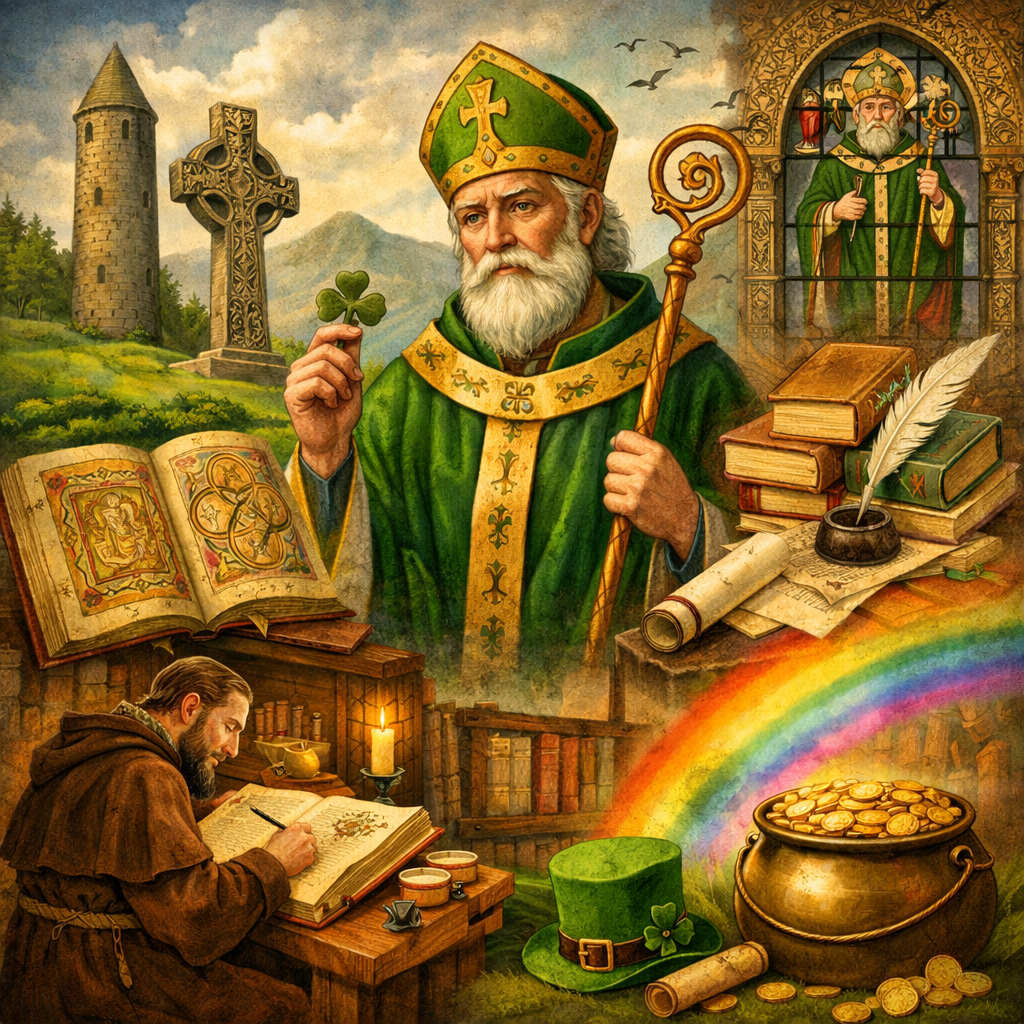
Patrick spent decades traveling across Ireland spreading Christianity, establishing churches, and teaching the faith. One well-known legend says he used the three-leaf shamrock to explain the Holy Trinity, making complex theological ideas easier to understand for the people he taught.
Patrick died on March 17 around the year 461 AD. The date eventually became a feast day in his honor.
Ireland: The Island That Saved Books
One of the most remarkable parts of Irish history often overlooked in St. Patrick’s Day celebrations is the role Ireland played in preserving knowledge and literature. After the fall of the Roman Empire around the 5th century, much of Europe entered a period where libraries disappeared and many classical texts were lost. During this time, Irish monks began creating scriptoriums—rooms dedicated to copying manuscripts by hand.
These monks meticulously copied religious texts, classical philosophy, history, poetry, and early literature. Their work preserved countless writings that might otherwise have disappeared forever. Many historians credit Irish monasteries with safeguarding major works of Western civilization during the early medieval period.
One of the most famous surviving examples of this artistic tradition is the Book of Kells, an illuminated manuscript created by Irish monks around the year 800 AD. The manuscript is renowned for its elaborate illustrations, intricate lettering, and breathtaking craftsmanship.
The Irish tradition of storytelling existed long before these manuscripts. Celtic culture was deeply rooted in oral storytelling, where poets and bards preserved myths, genealogies, and legends. When Christianity spread through Ireland, these stories slowly began to be written down. This merging of oral tradition and written record helped create one of the richest literary traditions in Europe.
The Evolution of St. Patrick’s Day
For centuries, St. Patrick’s Day was a quiet religious observance in Ireland marked by church services and family gatherings. Pubs were actually closed on March 17 for much of Irish history. The modern celebration we know today began largely with Irish immigrants in the United States during the 18th and 19th centuries. Facing discrimination and hardship, Irish communities used the holiday as a way to celebrate their identity and cultural pride.
The first recorded St. Patrick’s Day celebration in America took place in Boston in 1737, followed by the first parade in New York City in 1762. Over time these celebrations grew larger and more festive. Today St. Patrick’s Day is celebrated worldwide with parades, music, festivals, and cultural events.
The Color Green and Irish Identity
One of the most recognizable symbols of St. Patrick’s Day is the color green. Interestingly, the color originally associated with Saint Patrick was blue. Green became linked to the holiday because Ireland is often called the Emerald Isle, and the shamrock used in Patrick’s teachings is green. Irish political movements in the 18th century also adopted green as a symbol of Irish national identity. Over time wearing green on March 17 became one of the most recognizable traditions of the holiday.
A Celebration of Culture, Storytelling, and Words
Ireland’s literary legacy extends far beyond ancient manuscripts. The country has produced some of the most influential writers in history, including:
- James Joyce
- Oscar Wilde
- W.B. Yeats
- Samuel Beckett
- Seamus Heaney
Their works shaped modern literature and continue to inspire readers across the world. In many ways, the spirit of St. Patrick’s Day connects naturally with the world of books. It celebrates heritage, storytelling, imagination, and the passing of knowledge from one generation to the next.
Long before printing presses existed, Irish monks carefully copied manuscripts by candlelight, preserving stories and ideas that might otherwise have vanished. Because of their dedication, much of the literature and philosophy that shaped Western culture survived.
Why St. Patrick’s Day Still Matters
Today St. Patrick’s Day is often associated with celebration and fun, but its deeper meaning reflects something much more lasting. It is a reminder of how culture survives through stories, language, and the written word. From ancient monks preserving manuscripts to modern authors telling new stories, Ireland’s legacy is deeply tied to literature. Every book written and every story shared continues that tradition. And in many ways, that makes St. Patrick’s Day not just a celebration of Ireland—but also a celebration of the power of storytelling itself.

 Richter Publishing